

11.11.2026
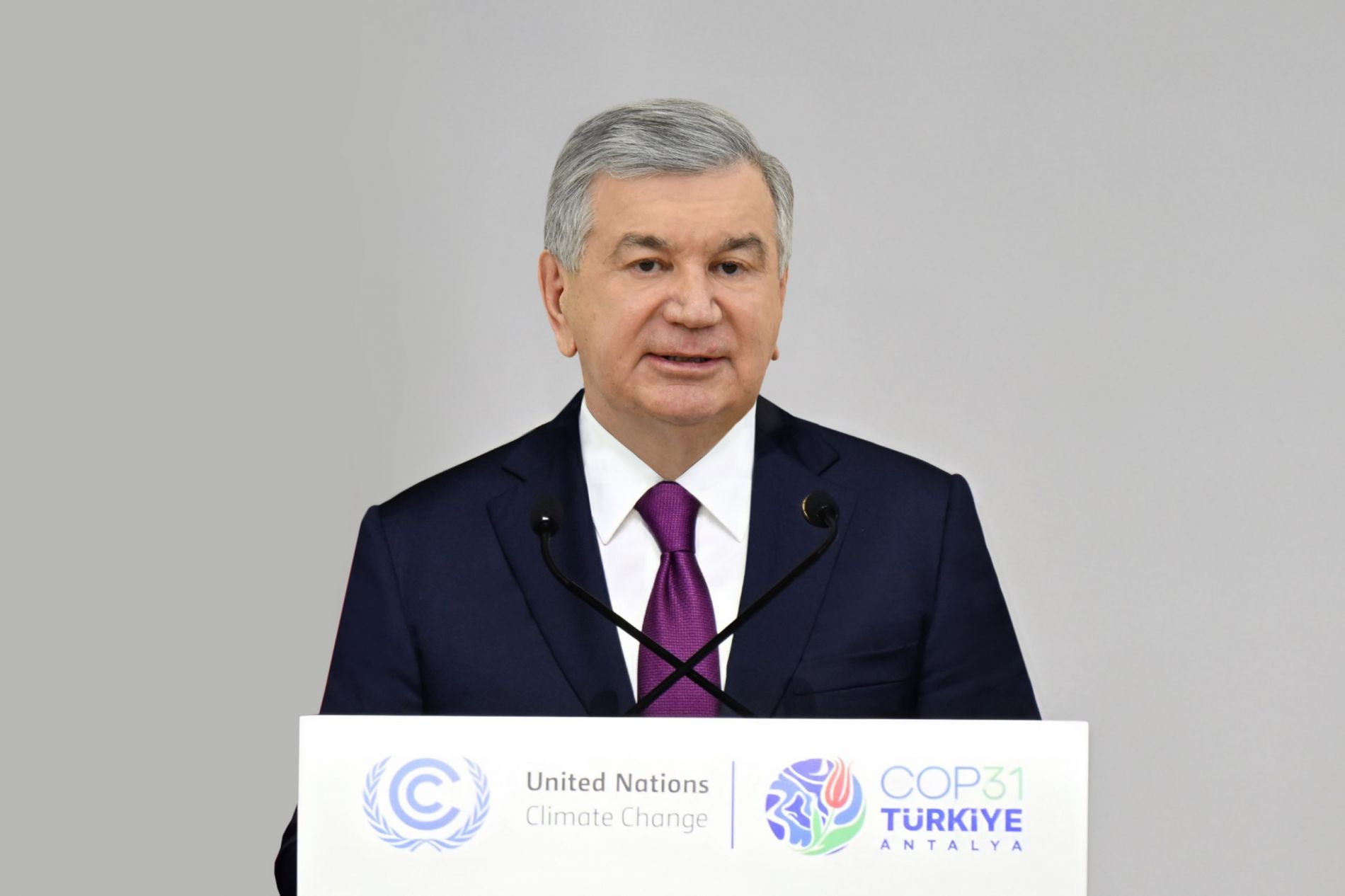
Dear President Recep Tayyip Erdoğan!
Distinguished Heads of State and Government!
Distinguished Chair of the Conference!
Ladies and Gentlemen,
First and foremost, I would like to express my sincere gratitude to the President of the Republic of Türkiye, my dear brother, His Excellency Recep Tayyip Erdoğan, for the traditionally warm hospitality extended to us here in Antalya, the pearl of the Mediterranean.
I would also like to commend the excellent preparations for this conference, jointly led by Türkiye and Australia.
Uzbekistan remains firmly committed to global efforts to address climate change. We are building a new development model founded on green technologies and the sustainable use of natural resources.
We are rapidly reducing carbon intensity across all sectors of our economy. Our country has already achieved, ahead of schedule, its target of reducing greenhouse gas emissions per unit of GDP by 35 percent.
We have set an even more ambitious target: to reduce harmful greenhouse gas emissions by 50 percent by 2035. Restoring the balance between economic development and the laws of nature requires a sustained increase in the share of clean energy. Over the next four years, the share of renewable energy sources in Uzbekistan will reach 54 percent.
We have also made firm commitments to the sustainable use of water resources, and our efforts in this area are already producing tangible results. Over the past decade, water consumption across our economy has fallen by nearly half, while water withdrawals from river basins have decreased by one-fifth. Water-saving technologies are now used on 60 percent of our irrigated land.
Beginning next year, Uzbekistan will assume the chairmanship of the International Fund for Saving the Aral Sea. We are fully prepared to carry out this important responsibility and ensure the effective management of transboundary water resources.
At the same time, we are undertaking large-scale land restoration efforts. Forested areas in our country have expanded by six million hectares, one-third of which is located in the Aral Sea region.
In addition, we have launched the Waste Management Strategy, under which more than $3 billion will be invested in this sector.
Youth policy is a central priority of Uzbekistan’s public agenda. As a popular proverb in our country says, “If you want a tree to bear fruit, nurture it while it is still a sapling.”
In Uzbekistan, children’s environmental education is built on the combined efforts of families, mahallas, and schools. From an early age, beginning in kindergarten, children learn to conserve water, plant and care for trees, and protect their environment.
One in five citizens of our country is a schoolchild or university student. Thanks to our systematic approach to environmental education and awareness, by 2050, three-quarters of Uzbekistan’s population will have a comprehensive knowledge of environmental protection.
Dear friends!
No country can address the challenges of climate change on its own.
Across Central Asia, threats such as melting glaciers, water scarcity, and extreme droughts are becoming increasingly severe. These shared challenges call for coordinated action by all countries in our region.
In this regard, we propose developing a Central Asian Climate Integration Model.
I propose that we launch this cooperation along three key pillars.
The first pillar is information.
With the support of the World Meteorological Organization, we need to establish an infrastructure for sharing information on climate risks. As a first step, we should establish an early warning system to enable timely and effective responses to natural disasters.
The next important step is to develop common indicators and coordinated mechanisms for monitoring slow-onset climate events.
The second pillar is technology.
Green technologies offer effective solutions for restoring degraded soils, capturing carbon in arid regions, and combating dust and sandstorms.
Every year, we host the Central Asia ECO-EXPO, where we exchange best practices and showcase promising innovations. We intend to transform this exhibition into a permanent investment and technology platform, bringing together modern environmental solutions tailored to the specific needs and conditions of our region.
The third pillar is finance.
Central Asia needs reliable and sustainable sources of financing that reflect the region’s specific conditions and needs.
To this end, we propose developing new financing instruments in cooperation with development banks, including concessional grants and innovative blue and arid financing mechanisms.
Distinguished Heads of Delegation,
We call on all countries and international organizations participating in this conference to help translate the Climate Integration Model into concrete action and give it meaningful practical substance.
We also propose extending this vital model to other regions of the world that are ready to embrace this approach.
Building a prosperous future and creating favorable living conditions for generations to come, while safeguarding our planet, is a sacred responsibility we all share.


When using materials reference to www.president.uz is required
© 2026 Official web-site of the President of Uzbekistan
All rights reserved
Attention! If you find an error in the text, select it and press Ctrl + Enter to notify the administration
